How is a mortgage payment calculated?
A fixed-rate mortgage payment comes from three numbers: how much you borrow, the interest rate and how many monthly payments you’ll make. A standard formula turns those into a level payment that pays off the loan by the end of the term. Taxes, insurance and other costs are added on top.
Want to skip the math? Try your own numbers in our U.S. mortgage calculator. The steps below are for a fixed-rate loan with monthly payments that’s fully paid off by the end of the term.
1. Find your loan amount
Take the purchase price and subtract your down payment. A $450,000 home with $90,000 down leaves a $360,000 loan. If you roll any fees into the loan, add them to this number. Fees you pay in cash at closing don’t change it.
Our down payment calculator compares different down payments in dollars and percentages, and the loan-to-value calculator shows your loan as a share of the home’s value.
2. Turn the rate and term into monthly numbers
Convert the annual rate to a decimal and divide by 12. At 6.5%, that’s 0.065 ÷ 12, or about 0.0054167 a month. Then multiply the years by 12: a 30-year loan has 360 payments.
Use the interest rate on your loan, not the APR. The APR includes some loan costs to help you compare offers, but your payment is calculated from the interest rate.
3. Plug the numbers into the formula
M = P × r ÷ [1 − (1 + r)−n]
- M is your monthly principal and interest payment.
- P is the amount you borrow.
- r is the monthly interest rate as a decimal.
- n is the number of monthly payments.
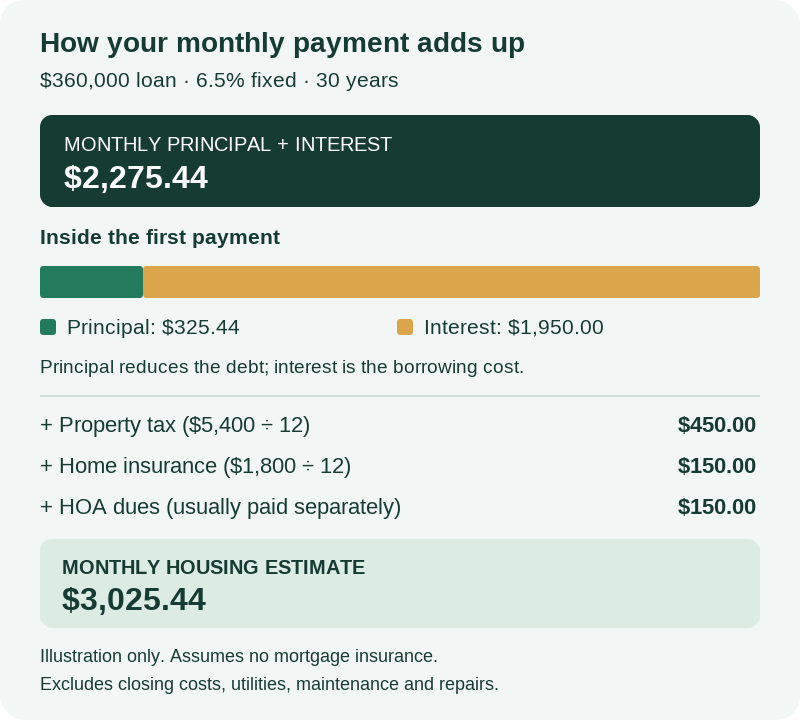
For $360,000 at 6.5% over 30 years, P = 360,000, r = 0.065 ÷ 12 and n = 360. That gives about $2,275.44 a month in principal and interest. The rate is an example, not a quote. If the rate were zero, you’d simply divide the loan by the number of payments.
4. See how each payment chips away at the balance
Each month, the interest is your balance times the monthly rate. Whatever’s left of your payment goes to principal, and the balance drops by that amount. Next month, you start again from the lower balance.
In the first month, interest is $360,000 × 0.065 ÷ 12 = $1,950.00. That leaves about $325.44 to pay down principal, so you owe about $359,674.56. Every month after, a little less goes to interest and a little more to principal. That’s amortization.
The amortization schedule in our calculator shows this month by month. Your lender’s schedule might differ by a few cents because of rounding or payment timing. Extra principal payments shorten the loan and cut interest, but they don’t lower your required monthly payment.
5. Add taxes, insurance and other costs
Principal and interest are only part of what you’ll pay each month. Divide your yearly property tax and homeowners insurance by 12, then add any mortgage insurance. Your lender may collect taxes and insurance through escrow. If it doesn’t, you’ll pay those bills yourself. HOA dues are usually paid straight to the association.
With $5,400 a year in property taxes, $1,800 a year in insurance and $150 a month in HOA dues, the total is $2,275.44 + $450 + $150 + $150 = $3,025.44 a month, with no mortgage insurance. That still leaves out utilities, maintenance and repairs. Your escrow amount can change even on a fixed-rate loan. The CFPB explains the difference between principal and interest and your total payment.
Use the numbers to compare loans
In the mortgage calculator, change one thing at a time and watch both the monthly payment and the total interest. A longer term lowers the payment but, at the same rate, costs more interest overall.
To check the payment against your income and debts, use our mortgage affordability calculator. If you’re thinking about replacing an existing loan, our refinance calculator shows the new payment and costs. For more on the total monthly figure, read How much will my monthly mortgage payment be?
This formula doesn’t cover adjustable-rate resets, interest-only periods, balloon payments or temporary buydowns. When you have a real offer, go by the figures on your lender’s Loan Estimate.