How Does a 1% Interest Rate Increase Affect Monthly Mortgage Payments?
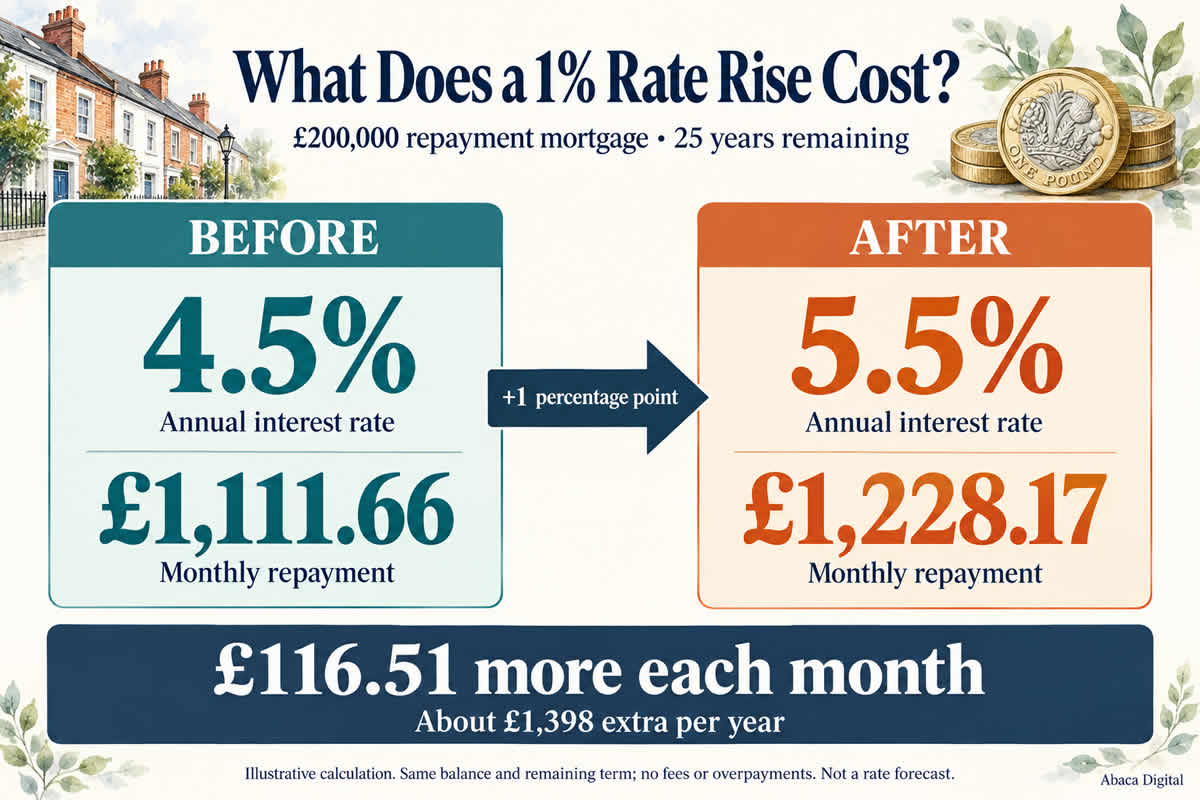
A one-percentage-point rise in your mortgage rate pushes your monthly payment up by far more than 1%. On a £200,000 repayment mortgage with 25 years left, going from 4.5% to 5.5% takes the payment from £1,111.66 to £1,228.17.
That’s £116.51 more a month, or about £1,398 a year. How much your own payment changes depends on what you owe, how long you have left and the type of deal you’re on.
A 1% rate rise isn’t a 1% payment rise
A “1% rise” almost always means one percentage point, so 4.5% becomes 5.5%. It doesn’t mean 4.5% growing by 1% of itself, which would only take it to 4.545%. This article uses percentage points throughout.
In the £200,000 example, the payment itself rises by about 10.5%. The exact figure depends on your starting rate and remaining term, as the table below shows.
How the remaining term changes the impact
Here’s what a move from 4.5% to 5.5% does to the monthly payment on the same £200,000 balance at different remaining terms.
| Remaining term | At 4.5% | At 5.5% | Monthly increase | Payment rise |
|---|---|---|---|---|
| 15 years | £1,529.99 | £1,634.17 | £104.18 | 6.8% |
| 20 years | £1,265.30 | £1,375.77 | £110.47 | 8.7% |
| 25 years | £1,111.66 | £1,228.17 | £116.51 | 10.5% |
| 30 years | £1,013.37 | £1,135.58 | £122.21 | 12.1% |
The 30-year term has the lowest payment at both rates but the biggest increase, in pounds and in percentage terms. A longer term lowers your payment, but it doesn’t protect you from a rate rise. If anything, it leaves you more exposed, because more of each payment is interest.
The figures assume a repayment mortgage, interest charged monthly at the annual rate divided by 12, no fees or overpayments, and each rate lasting for the full remaining term. Your lender’s figures may differ slightly because of daily interest, payment dates or rounding.
Why balance × 1% overstates the rise
A common shortcut is balance × 1% ÷ 12, which gives £166.67 on £200,000. That’s the extra interest on an unchanged balance, not the change in a repayment mortgage’s payment.
On a repayment mortgage, the payment is recalculated so the balance still clears by the end of the term. In the first month of the 25-year example, interest rises from £750 to £916.67, but the capital repaid falls from £361.66 to £311.50. The payment goes up by the difference between those two changes, about £116.51, not the full £166.67.
On an interest-only mortgage, the shortcut is accurate. Payments only cover interest, so moving from 4.5% to 5.5% on £200,000 takes them from £750 to £916.67 a month. The £200,000 itself still has to be repaid at the end of the term.
When a rate rise reaches your payment
A Bank of England base rate rise doesn’t change every mortgage overnight. It depends on your deal.
- Fixed rate: your rate stays the same until the fixed period ends. You feel higher rates when you choose your next deal.
- Tracker: your rate follows the rate named in your agreement, usually Bank Rate plus a set margin. When it changes, and any limits, depend on your product.
- Standard variable rate: your lender sets it. It doesn’t have to move by the same amount as Bank Rate or on the same day.
Check your mortgage offer and any letter from your lender about payment changes. MoneyHelper’s guide to mortgage interest rates explains how each type works.
Work it out for your own mortgage
Use what you owe now, not what you first borrowed. If you started with £250,000 and now owe £210,000, use £210,000. Use the time actually left too: five years into a 25-year mortgage, that’s normally 20 years.
- Open our UK mortgage calculator and enter your current balance and remaining term.
- Note the monthly payment at your current rate.
- Add one percentage point to the rate and calculate again.
- Subtract the first payment from the second. That’s your estimated increase.
If the calculator asks for a price and deposit, set them so the loan matches your balance. Leave out Council Tax, insurance and service charges for this comparison. They matter for your budget, but not for the rate change.
At the same rate and term, the increase scales with your balance, so £100,000 rises by about half as much as £200,000. Change the rate or term and you’ll need to recalculate.
Check it against your budget
Compare the increase with what’s left each month after essentials and other commitments. If you can, start putting that amount aside now. It tests whether the higher payment is manageable and builds a buffer at the same time. Try a few higher rates too, to see where things start to feel tight.
When you compare new deals, check whether the quoted payment uses the same remaining term. A longer term can make a deal look cheaper each month while adding interest overall. Count product fees and any early repayment charge as well. MoneyHelper’s remortgaging guide covers what to compare.
If you’re worried about keeping up, contact your lender before you miss a payment. Lenders can offer options such as a temporary switch to interest-only or a longer term, and the FCA explains the support available. MoneyHelper also has free guidance if you’re worried about rising mortgage costs.