Principal vs interest
Lifetime mortgage repayment
Principal£0
Interest£0
Estimate monthly repayments using UK mortgage terminology, costs, and conventions.
Lifetime mortgage repayment
How your remaining principal declines
Annual summary including overpayments
| Year | Capital repaid | Interest | Overpayments | Total paid | Balance remaining |
|---|
See how monthly payments and total interest change across different deposits and terms.
See how your repayment and total interest could change if the mortgage rate rises.
This scenario holds the higher rate constant for comparison. Your actual fixed, tracker, variable or follow-on rate may differ.
Add regular overpayments or a lump sum to estimate the interest and time you could save.
UK planning estimate only. Council tax, buildings insurance and service charges vary by nation, council and property. Product fees, affordability checks, purchase taxes and early-repayment charges are not included.
Enter the property price, deposit, term and interest rate to see how much you’d borrow, your monthly repayment, the total interest and how the balance falls year by year. It works for residential and buy-to-let repayment mortgages.
Treat the result as a guide, not a mortgage offer. A lender will look at your income, spending, debts, credit history, deposit and the property before deciding what to lend.
Want to compare a range of figures at a glance? See our UK mortgage repayment tables for monthly payments across different loan amounts, rates and terms.
Each monthly payment covers that month’s interest and pays off some of the loan. In the early years most of it goes on interest. As the balance falls, a bigger share clears the debt, so by the end of the term you owe nothing. With an interest-only mortgage, the monthly payment covers just the interest and the full loan is still owed at the end. MoneyHelper compares repayment and interest-only mortgages.
A bigger deposit means a smaller loan and a lower loan-to-value (LTV). Lenders usually price deals in LTV bands, so moving from 90% to 85% LTV can unlock a lower rate. Rates and approval still depend on the lender.
A longer term lowers the monthly payment, but you owe the money for longer and pay more interest in total. Try 15, 20, 25 and 30 years to see the trade-off.
The calculator keeps your rate the same for the whole term. In reality, a fixed deal usually lasts two to five years, and tracker and variable rates can move at any time. Use the stress test to see what a higher rate would cost.
An affordable-looking payment doesn’t mean a lender will offer that loan. Lenders check your income and outgoings, and whether you could keep paying if rates rose. If payments do become hard to manage, the FCA explains the support lenders can offer.
Paying extra reduces the balance sooner, so you pay less interest overall, as long as the rate stays the same. Add a monthly, yearly or one-off overpayment to see how much sooner you’d be mortgage-free compared with the standard schedule.
Check your mortgage terms first. Many fixed and discounted deals cap penalty-free overpayments, often at 10% of the balance a year, and charge an early repayment charge above that. Because limits vary by lender, the calculator doesn’t deduct any charge. MoneyHelper explains paying off a mortgage early.
The repayment figure leaves out arrangement and booking fees, valuation, legal and broker fees, removals and property tax. Property tax depends on where you buy. Stamp Duty Land Tax applies in England and Northern Ireland, Land and Buildings Transaction Tax in Scotland and Land Transaction Tax in Wales. Check the GOV.UK guide for England, Northern Ireland and Wales or Revenue Scotland for LBTT.
Mortgage lending in Britain owes a lot to building societies. The first one on record was set up by Richard Ketley at the Golden Cross Inn in Birmingham in 1775. Members paid into a shared fund, and the money was used to build or buy homes for them one by one. Once everyone had a house, the society closed. Societies that stayed open for new savers and borrowers appeared from the 1840s, and that model survives today. Building Societies Association history.
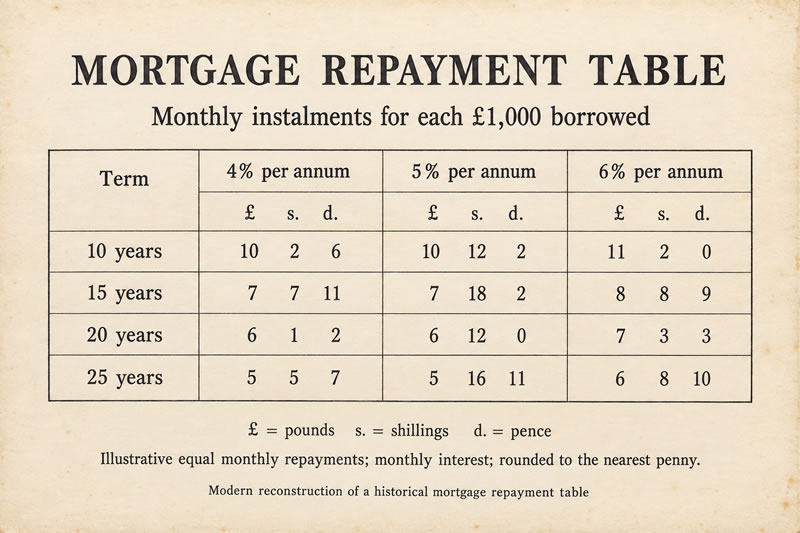
Clerks relied on printed repayment tables and handwritten ledgers. A table gave the payment for a standard loan at a set rate and term, and staff scaled it up or down to fit each borrower. Until decimalisation in 1971, all of this was done in pounds, shillings and pence.
Ledger examples from the Birmingham Municipal Bank show two kinds of loan. An “equated” mortgage had equal payments throughout. A “reducing” mortgage had payments that shrank as the balance fell. The equated version is the one this calculator models: interest falls as the debt shrinks, so more of each payment goes on capital. Computers made the sums faster, but the maths hasn’t changed.
The repayment maths is the same everywhere. The difference in the UK is that the mortgage term and the rate deal are separate. You might borrow over 25 years but fix the rate for only two or five. In the US, by contrast, many borrowers fix for the full 30 years.
So UK borrowers usually move onto a new rate several times before the mortgage is paid off. Each time a deal ends, the payment is recalculated from the remaining balance, the remaining term and the new rate. If you don’t arrange a new deal, you move onto the lender’s follow-on rate, usually its standard variable rate.
In November 1979, the Bank of England’s Minimum Lending Rate hit 17%. That was the central bank’s rate rather than a mortgage rate, but it shows what borrowers were up against. More recently, Bank Rate climbed from 0.1% in late 2021 to 5.25% by August 2023.
Rates make a big difference to the payment. A £200,000 repayment mortgage over 25 years costs about £948 a month at 3% and £1,289 at 6%, assuming the rate stays fixed and no fees are added.
Bank Rate isn’t your mortgage rate, so use the rate on your offer when comparing. A low rate alone doesn’t make a home more affordable, either. Prices, wages and other bills matter just as much. Fixed-rate borrowers feel a change when their deal ends, while tracker borrowers feel it almost straight away.
Read the balance after year two from the schedule, then run the calculator again using that balance, the remaining term and a likely new rate. For example, £200,000 over 25 years at 4.5% costs £1,112 a month and leaves about £190,900 after two years. Over the remaining 23 years, that balance would cost about £1,221 a month at 5.5%, or £1,008 at 3.5%.
The savings are similar, but the commitment isn’t. On £200,000 at 4.5%, overpaying £100 a month clears a 25-year mortgage about three and a half years early and saves around £21,000 in interest. Cutting the term to 22 years means a fixed payment of about £1,195 and similar savings, but you’re locked into it. Overpayments can usually be stopped if money gets tight, as long as you stay within your lender’s overpayment limit.
Adding the fee spreads the cost, but you pay interest on it for the whole term. A £999 fee added to a 25-year mortgage at 4.5% adds about £5.55 a month and roughly £670 in interest. To compare, add the fee to the loan amount in the calculator and look at the change in total interest.
Your first payment usually includes extra interest for the days between completion and your first full month, so it’s often higher. Lenders may also charge interest daily, take payment on a set date or add fees to the loan. This calculator assumes equal monthly payments from day one, so use your lender’s illustration for the exact figures.
Yes, if it’s a repayment buy-to-let. Many buy-to-let mortgages are interest-only, where the monthly cost is the loan multiplied by the rate, divided by 12. For example, £150,000 at 5% is £625 a month. Lenders also check that the expected rent covers the interest with a margin to spare, usually at a higher test rate.
The mortgage repayment, plus any Council Tax and buildings insurance you enter, converted from yearly to monthly, and any monthly service charge. These extras don’t reduce your mortgage. Stamp duty and other purchase costs aren’t included, as they’re paid upfront.
Your home may be repossessed if you do not keep up repayments on your mortgage.