Can High Fuel Prices Affect Your UK Mortgage?
Higher petrol and diesel prices do not automatically change your mortgage payment. They can, however, leave less money available to cover it. For UK households, the most immediate connection between fuel prices and a mortgage is the monthly budget.
There is also a wider economic connection: energy costs can contribute to inflation, which can influence interest-rate decisions and the pricing of new mortgage deals. These are separate effects, and understanding the difference helps you plan without assuming that every increase at the pump means a higher mortgage rate.
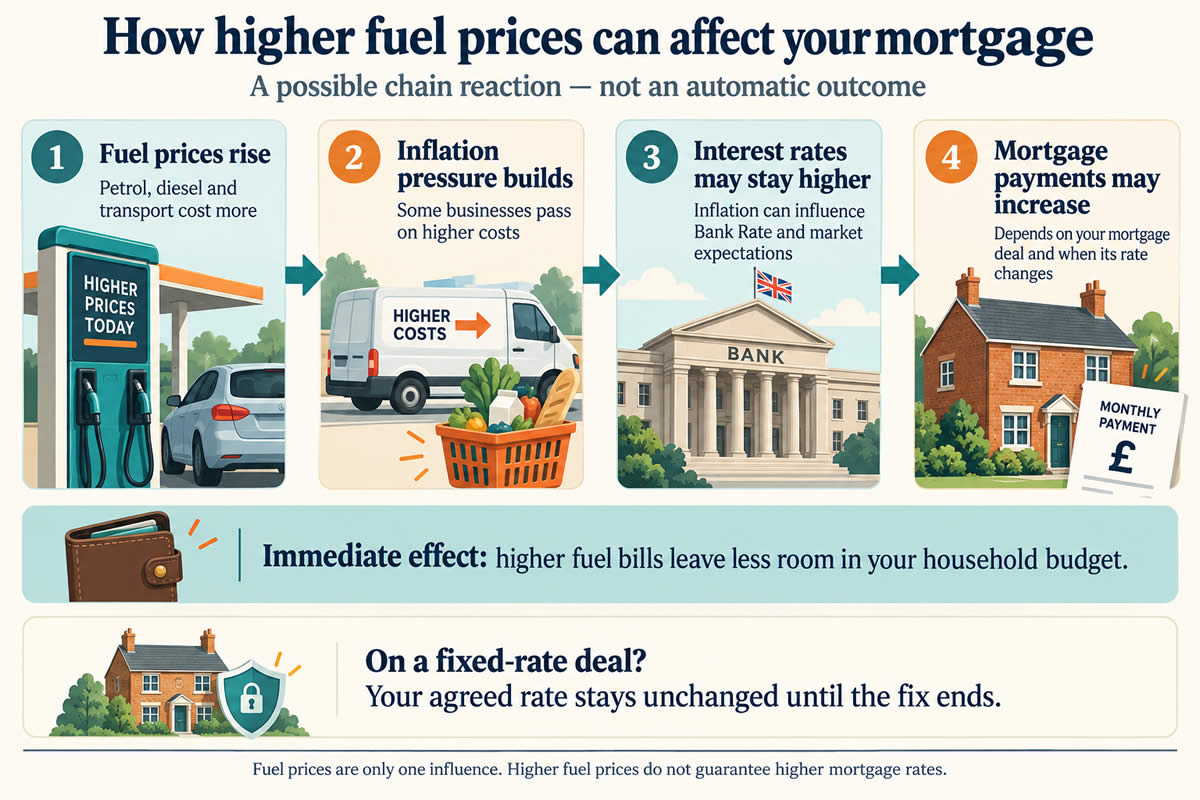
Your payment can stay the same while your budget gets tighter
Consider a household that uses 150 litres of petrol each month for commuting, school runs and other journeys. If petrol rises from £1.40 to £1.60 per litre, the monthly fuel bill increases from £210 to £240.
| Expense | Before | After |
|---|---|---|
| Mortgage payment | £1,100 | £1,100 |
| Petrol: 150 litres | £210 | £240 |
| Combined monthly cost | £1,310 | £1,340 |
The mortgage has not become more expensive, but the household has £30 less available each month. Over a year, that is £360 that would otherwise be available for savings, repairs or other spending. The fuel prices and mortgage payment above are examples, not current market quotes.
To estimate the change in your own fuel bill, multiply your monthly litres by the price increase per litre. Use pounds consistently: 150 litres multiplied by £0.20 gives £30. If your mileage changes too, calculate the new total fuel bill rather than attributing the whole difference to prices.
Could fuel spending reduce what you can afford to borrow?
When preparing for a mortgage, income is only one side of the calculation. Essential spending, existing repayments and other commitments determine how much room you have for housing costs. A long commute can make that room smaller, even if your salary has not changed.
Travel is one of the spending categories included in MoneyHelper's affordability tool, alongside costs such as childcare and bills. Its published explanation of the affordability calculation shows why an income multiple alone does not describe a household's budget.
Our UK mortgage affordability calculator can help you explore a starting borrowing budget. Review its assumptions and compare the estimate with your actual spending, including petrol, diesel, parking and car finance. The result is a planning estimate, not a lender's approval.
There is no universal rule that an extra £30 spent on fuel reduces a mortgage offer by a particular amount. A lender's decision depends on its assessment and your wider circumstances. If you are moving home, budget for the journey from the new property: a lower purchase price may come with higher commuting costs.
How fuel prices can feed into inflation
Higher energy prices can affect households directly through motor fuel and heating costs. They can also raise businesses' transport and production costs, some of which may feed into other prices. The Bank of England's analysis of energy costs and inflation explains these direct and indirect channels.
For example, a delivery business paying more for diesel might absorb the extra cost, increase delivery charges or pass some of it into product prices. The effect on inflation depends on how widely those costs spread, how much businesses pass on and what happens to other prices.
How inflation can affect interest rates
If inflation is expected to remain too high, the Bank of England may raise Bank Rate or keep it higher for longer. Higher interest rates make borrowing more expensive and can encourage saving, reducing spending pressure over time. They do not directly produce cheaper oil or increase the supply of fuel.
The Bank of England explains this spending-and-saving mechanism in its guide to how higher interest rates help to lower inflation. Fuel prices are only one part of the assessment: a household spending more on commuting may cut back elsewhere, so the wider effect also depends on how people and businesses respond.
There is no fixed conversion from petrol prices to mortgage rates. A 10% increase in the price of fuel does not imply a one-percentage-point mortgage rate rise, and falling fuel prices do not guarantee that a lender will cut its rates.
What this means for your mortgage deal
- Fixed rate: more expensive fuel does not alter the fixed mortgage rate in your agreement. Your spending can still rise, and a different mortgage rate may apply when your fixed period ends.
- Tracker: your mortgage follows the benchmark named in the agreement, often Bank Rate. Any payment change depends on that benchmark and the product's timing, margin and other conditions.
- Standard variable rate: the lender sets the rate. It does not have to change by the same amount as Bank Rate or follow fuel prices.
Rates offered on new fixed deals can move even when Bank Rate has not changed. Financial-market expectations help shape their pricing: the Bank of England identifies overnight indexed swap rates as important reference rates for fixed-rate mortgages. Your existing fixed deal and the deals available to new applicants are therefore different things.
Why fixed-rate borrowers may not notice immediately
A fixed-rate deal protects the agreed mortgage rate for a specified period, not the household's entire cost of living. Someone with two years left on their fix can face a higher petrol bill straight away while their scheduled mortgage payment remains unchanged, assuming no other changes to the loan.
The mortgage effect may arrive later, when that deal ends and the borrower takes a new deal or moves onto the lender's follow-on rate. The new payment will depend on the rate available then, the outstanding balance and the remaining term. A fuel-price rise today does not tell you what that future rate will be.
Test a higher fuel bill and mortgage payment separately
Suppose you owe £200,000 on a repayment mortgage with 25 years remaining. At an illustrative annual rate of 4.5%, the estimated payment is £1,111.66 a month. At 5.5%, it becomes £1,228.17, approximately £116.51 more each month.
If your fuel spending also rises by £30, the combined additional commitment is approximately £146.51 a month. This is a budget scenario, not a claim that the fuel increase causes the mortgage rate to rise.
Use our UK mortgage calculator to compare your current rate with an alternative. Keep the loan balance and remaining term unchanged to isolate the rate's effect. Add the extra fuel cost separately to your household spending, rather than adding it to the mortgage balance.
The repayment example assumes monthly capital-and-interest payments, monthly interest at the annual rate divided by 12, and no fees or overpayments. Each payment is calculated assuming its rate applies for the remaining term. Actual lender figures can differ because of payment dates, daily interest and rounding.
What if fuel prices fall?
Lower pump prices can improve your monthly budget before anything changes on your mortgage. If the example household still buys 150 litres a month and petrol falls from £1.60 back to £1.40 per litre, it saves £30 a month. Its mortgage payment does not automatically fall alongside the fuel bill.
Cheaper fuel can ease inflation pressure, all else being equal. But a fall in one price does not mean prices generally are falling, or that the Bank of England will immediately cut rates. The wider inflation outlook and economic conditions still matter.
If Bank Rate subsequently falls, a tracker mortgage linked to it may become cheaper according to its terms. A lender decides whether to change its standard variable rate, while an existing fixed rate stays unchanged for the agreed period. New fixed-rate offers can also reflect expectations before an official rate decision.
Checks to make before changing your mortgage
- Review actual travel spending. Include regular journeys and other vehicle costs, rather than relying on one unusually expensive fill-up.
- Check your deal's end date. A fixed-rate borrower approaching renewal has a different decision to make from someone with several fixed years remaining.
- Compare fees as well as rates. Product fees and early repayment charges can affect whether switching makes financial sense.
- Keep an eye on the repayment term. Extending it can reduce the monthly payment but increase total interest. Compare deals over the same remaining term first.
- Allow for unexpected costs. A budget that only works when fuel, repairs and other bills stay at their lowest leaves little room for change.
If rising living costs could make your mortgage payments difficult, contact your lender before missing a payment. The FCA's mortgage support guidance encourages borrowers to discuss affordability concerns promptly.
For most households, the useful first step is to calculate the additional fuel spending, then examine mortgage-rate scenarios separately. That shows what you can control in today's budget and what you may need to prepare for when your mortgage deal changes.
This article provides general information and illustrative calculations, not personalised mortgage advice. Example prices and rates are not current offers or forecasts. Confirm your mortgage terms and available support with your lender.
Fuel prices and UK mortgages: common questions
Do higher fuel prices automatically increase my mortgage repayment?
No. Petrol and diesel prices do not directly determine your mortgage payment. They increase your travel spending and can contribute to inflation, which may influence interest rates. Whether your mortgage repayment changes depends on your mortgage type and the terms of your agreement.
How can rising fuel prices affect mortgage interest rates?
More expensive fuel can raise transport and business costs. If businesses pass those costs on to customers, this can add to inflation. Persistent inflation may lead the Bank of England to raise Bank Rate or keep it higher for longer. Expectations about future rates can also affect new mortgage pricing before Bank Rate changes. Fuel prices are only one influence, so this chain is not guaranteed.
Will my fixed-rate mortgage change if fuel prices rise?
Your agreed interest rate stays unchanged during the fixed period. Assuming no other changes to the loan, your scheduled repayment stays the same, although higher fuel bills can leave less money available each month. When your fix ends, your repayment will depend on your next mortgage rate, outstanding balance and remaining term.
How much could higher fuel costs and mortgage rates add to my monthly budget?
For a household buying 150 litres a month, a fuel price increase from £1.40 to £1.60 per litre adds £30 to monthly spending. Separately, a £200,000 repayment mortgage with 25 years remaining costs approximately £1,111.66 a month at 4.5%, or £1,228.17 at 5.5%. Together, these illustrative changes add about £146.51 a month. The mortgage calculation assumes monthly interest and excludes fees; it does not imply that the fuel increase causes the rate change.
Can higher commuting costs affect how much mortgage I can afford?
Higher commuting costs leave less income available for mortgage repayments and other commitments. Include fuel, parking, car finance and regular vehicle expenses when reviewing your budget, especially if moving would change your journey to work. There is no fixed formula linking an extra pound of fuel spending to a reduction in borrowing: lenders assess your wider financial circumstances.
Will my mortgage become cheaper if fuel prices fall?
Lower fuel prices can reduce your household spending immediately, but they do not automatically lower your mortgage payment. They may ease inflation pressure without prompting an immediate interest-rate cut. A tracker linked to Bank Rate may become cheaper if that benchmark falls, subject to its terms. Standard variable rates are set by lenders, while an existing fixed rate remains unchanged during the fixed period.