Should I Choose a 2-, 5- or 10-Year Fixed Rate?
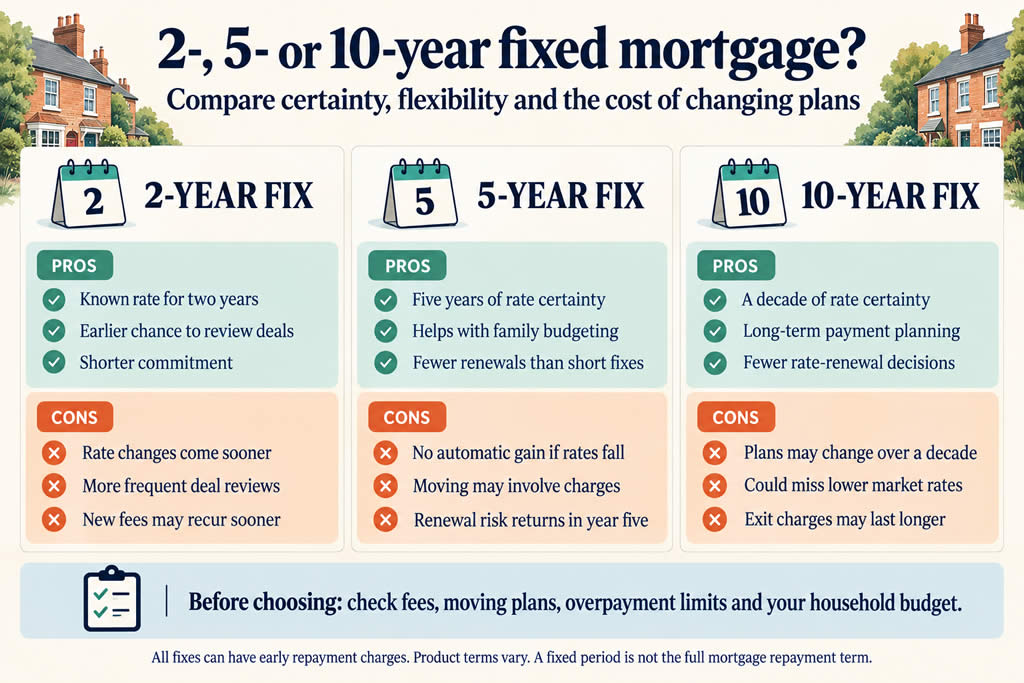
A two-year fix brings your next mortgage decision closer. A five-year fix keeps the agreed rate in place for longer, while a ten-year fix offers a decade of rate certainty. The longer you commit, the more important it becomes to check what happens if you move, repay a lump sum or need to change the loan. None of these periods is automatically the cheapest or best choice.
For a UK homeowner, the useful question is how long you want a known mortgage rate and how likely you are to need a different arrangement during that time. Start with your budget and plans, then compare the actual products available to you.
First, separate the fixed period from the mortgage term
A five-year fixed-rate deal does not mean repaying the entire mortgage in five years. You might have a 25-year repayment mortgage with an interest rate fixed for the first five. After that, the remaining balance still needs to be repaid, normally over the 20 years left if you have followed the original schedule.
During the fix, your agreed rate remains unchanged. Scheduled capital-and-interest payments normally stay the same too, provided you do not change the loan. When the deal ends, you can consider a new deal; otherwise, the lender's follow-on rate generally applies. Check the exact expiry date and conditions in the mortgage illustration.
If you are deciding how quickly to repay the whole loan, read our guide to choosing your mortgage term. That is a separate decision from how long to fix the rate.
Two, five and ten years at a glance
| Fixed period | Main benefit | Main trade-off | Question to ask |
|---|---|---|---|
| 2 years | An earlier scheduled chance to review your rate and lender. | You face the next rate decision sooner and may incur new deal costs more often. | Could my budget cope if the next deal costs more? |
| 5 years | A known rate through a longer stretch of household spending. | Changing the mortgage during the fix may trigger charges. | How likely am I to move or change borrowing within five years? |
| 10 years | A decade of protection from changes to the agreed mortgage rate. | A long period in which your circumstances or available market rates could change. | Do the product's exit and overpayment rules fit my longer-term plans? |
The table describes typical considerations, not universal product rules. Early repayment charges, overpayment allowances and portability differ between mortgages. MoneyHelper's guide to mortgage interest-rate options explains the underlying features.
When might a two-year fix make sense?
A shorter fix may be worth considering if a house move, a change in work or a substantial repayment is likely relatively soon. It gives you a nearer date at which to reassess the mortgage, although plans that bring you out of the deal before that date can still involve charges.
It can also appeal to someone who wants an earlier opportunity to access new rates. That opportunity works both ways: the next rate may be lower or higher, and your eligibility may have changed. Choosing two years solely because you expect rates to fall leaves your budget exposed if that expectation is wrong.
Remember the time and possible costs of arranging another deal. Product fees, broker fees and legal or valuation costs can matter, although not every switch carries all of them.
Check the date on which any early repayment charge ends; do not assume that every exit cost disappears when the fixed rate expires. A mortgage exit or administration fee may still apply, and a replacement deal may have its own charges.
Pros of a two-year fix
- A nearer expiry date can fit plans to move or change your borrowing in a few years.
- You can review new deals sooner if rates fall or your circumstances improve.
- Your agreed rate remains predictable during the two-year period.
Cons of a two-year fix
- You face the possibility of a higher replacement rate sooner.
- Repeated short deals can mean more frequent fees and administration.
- Leaving before the fixed period ends may still trigger an early repayment charge.
What does a five-year fix offer?
Five years can cover a meaningful period of family life: nursery costs, a planned career change or the first years in a new home. Knowing the mortgage rate throughout that period may make the rest of the budget easier to organise.
Consider an imagined household expecting high childcare costs for the next four years. A five-year fix could keep one major payment predictable during that period. But if the same household expects to relocate in year three, the ability to move the mortgage and the potential exit charge become just as important as the rate.
A five-year deal is not automatically a sensible compromise simply because it sits between two and ten. Its value depends on the quoted cost and whether those five years fit your circumstances.
Pros of a five-year fix
- Five years of rate certainty can help with planning around childcare and other regular commitments.
- You avoid having to choose a replacement rate after just two years.
- Keeping the same deal can reduce the frequency of switching work and possible new product fees.
Cons of a five-year fix
- You do not automatically benefit if new mortgage rates fall during the fix.
- A move or large repayment within five years may bring charges or require lender approval.
- Protection ends after five years, so a future payment increase still needs consideration.
When is a ten-year fix worth considering?
A ten-year fix may appeal if you expect to keep the property and borrowing broadly unchanged and place a high value on predictable payments. It removes several potential rate-renewal decisions during that decade.
However, ten years allows plenty of time for a move, separation, inheritance or change in income. Check what it would cost to repay, reduce or replace the mortgage during each year of the deal. A long fix can also leave you paying more than newly available deals if market rates fall; accessing a cheaper rate may involve an early repayment charge.
Do not assume longer fixes always have higher rates. The pricing relationship between two-, five- and ten-year products can change. Compare actual quotes for the same loan, property value and repayment term.
Pros of a ten-year fix
- Your agreed rate is protected from market increases for a decade.
- A long period of predictable repayments can support household planning when the loan stays unchanged.
- You avoid arranging replacement deals solely because a shorter fix expires during those ten years.
Cons of a ten-year fix
- It is harder to anticipate housing, family and borrowing needs over a full decade.
- You could remain on a higher rate than new deals if market rates fall.
- Early repayment charges and overpayment restrictions may limit changes for a long period; check the specific schedule.
Put the monthly difference into pounds
Suppose you need a £200,000 repayment mortgage over 25 years. At an illustrative 4.5% annual rate, the payment is approximately £1,111.66 a month. At 5%, it is approximately £1,169.18: a difference of £57.52 a month.
Those rates are examples, not quotes assigned to particular fixed periods. If a longer fix carries the higher rate in your own comparison, the payment difference shows what extra certainty would initially cost in your budget. It does not establish which deal will be cheaper over ten years, because future rates after a shorter fix are unknown.
To see what the two-, five- and ten-year deals you have been offered would initially cost each month, enter each quoted rate into our UK mortgage calculator. Keep the balance and full repayment term unchanged: a five-year fix on a 25-year mortgage should use 25 years for this calculation. For a quick overview of other balances and rates, browse the mortgage repayment tables.
The example assumes monthly capital-and-interest repayments, monthly interest at the annual rate divided by 12, and no fees or overpayments. Each payment is calculated over the full repayment term at its example rate; this does not mean an introductory fixed rate will last for that whole term.
Compare fees and balances, not just monthly payments
A lower rate with a large product fee can be less attractive than it first appears, particularly on a smaller mortgage. If a fee is added to the loan, it also increases the balance on which interest is charged.
As a simple illustration, a £999 fee is equivalent to £41.63 per month when spread over 24 months, or £16.65 over 60 months. These figures only help put the upfront fee in context; they exclude interest on financed fees and do not measure the full cost of a mortgage.
When comparing different fixed periods, choose a common comparison date. Include scheduled payments, fees, cashback and the outstanding balance at that date. For the period after a shorter fix expires, test several possible replacement rates and allow for potential new fees. Adding up payments alone can hide the fact that one option leaves more debt outstanding.
A comparison cannot tell you today's guaranteed winner over ten years when some future rates are unknown. It can show which option remains manageable under different assumptions.
Moving home: a portable mortgage is not a guarantee
Some mortgages can be transferred to a new property, a process known as porting. This is subject to the lender accepting the new property and your application under its requirements at the time. Needing additional borrowing can also mean taking a separate part of the loan at a different rate.
If moving is plausible during the fix, ask what happens if porting is refused, you buy a cheaper home or there is a gap between selling and buying. MoneyHelper's remortgaging guidance discusses these moving and borrowing considerations.
Read the early repayment charge schedule rather than relying on the word portable. For illustration, a 3% charge applied to £180,000 would be £5,400. Your product may use different percentages, allowances or calculation rules, so request an actual figure before acting.
Check overpayments and your next affordability test
If you expect to make regular extra payments or repay a lump sum, compare the allowance and how the lender measures it. A limit may be based on a particular balance and reset date; exceeding it can trigger a charge. Do not assume the same allowance applies to every fixed-rate mortgage.
Also consider your circumstances when a short fix ends. Lower income, new credit commitments or a changed property valuation could affect the deals available. A product transfer with your existing lender and a remortgage to another lender can have different requirements.
If choosing a fixed period is part of planning a purchase, use our UK mortgage affordability calculator to explore a starting borrowing estimate. Then compare the repayments for your shortlisted deals with your actual household spending. An affordability estimate does not guarantee approval or establish which fixed period suits you.
Five questions before choosing your fixed period
- How long do I expect to keep this home? Consider realistic moving plans alongside the fixed-rate expiry date.
- How much payment uncertainty can my budget absorb? Test a higher rate at the end of a shorter fix using the expected balance and remaining term.
- What would changing the mortgage cost? Check early repayment charges, portability and overpayment rules.
- What is included in each quote? Compare fees and incentives as well as rates, using consistent assumptions.
- Am I choosing around my plans or a rate prediction? A deal should remain workable even if the market moves differently from expectations.
Two years brings an earlier review point, five years provides a longer period of certainty, and ten years keeps the agreed rate in place for a decade. The decision is how much certainty you want and what flexibility you may need. A mortgage adviser can help assess specific products against those priorities.
This article provides general information about UK mortgages, not personalised mortgage advice. Rates, charges and calculations are illustrative, not current offers or forecasts. Confirm product conditions and repayments with your lender or mortgage adviser.
Questions about UK fixed-rate mortgages
Is a two-year or five-year fixed mortgage better?
A two-year fix gives you an earlier opportunity to review your deal, while a five-year fix provides longer certainty about your interest rate. Compare the quoted repayments, fees and early repayment charges alongside your moving plans and ability to afford a higher rate when the fix ends. Neither option is best for everyone.
Is fixing my mortgage for ten years a good idea?
A ten-year fix may suit someone who values predictable repayments and expects to keep their home and borrowing broadly unchanged. The drawbacks include potentially missing lower market rates and facing charges if plans change. Check the product's early repayment charge schedule, portability conditions and overpayment allowance before committing.
Will my fixed mortgage payment fall if UK interest rates fall?
No. A fall in Bank Rate or rates offered on new mortgages does not automatically change your existing fixed rate. Your scheduled repayment normally stays the same during the fixed period if the loan is unchanged. Switching early to a lower rate may involve charges and fees that outweigh the saving.
Can I move home during a fixed-rate mortgage deal?
You may be able to transfer your existing deal to another property through a process called porting. This depends on your lender accepting the new property and your application. Additional borrowing may have a different rate, and early repayment charges may apply if you cannot port or repay part of the mortgage. Check the conditions before committing to a move.
Does a five-year fix mean my mortgage is repaid in five years?
No. The fixed period determines how long your agreed interest rate lasts. The repayment term determines how long you have to repay the loan. For example, a 25-year repayment mortgage with a five-year fix would normally have 20 years remaining when the fix ends, assuming you follow the original payment schedule without changes.
How should I compare the cost of different fixed-rate periods?
Start with the same loan amount and full repayment term, then compare monthly payments at each quoted rate. Include product fees, other charges and cashback. For a longer comparison, use a common end date and consider the outstanding balance as well as payments made. A shorter fix requires assumptions about replacement rates and fees, so test several scenarios rather than assuming future savings.