What Is the Difference Between a Fixed-Rate and Variable-Rate Mortgage?
A fixed-rate mortgage keeps your interest rate the same for a set period, so your payment doesn’t change. A variable-rate mortgage can change during the deal, so your payment can go up or down. A tracker is one kind of variable mortgage: its rate follows a named rate, usually the Bank of England’s Bank Rate.
Which you choose affects how easily you can budget and how freely you can switch. Knowing what controls your rate tells you more than comparing first payments.
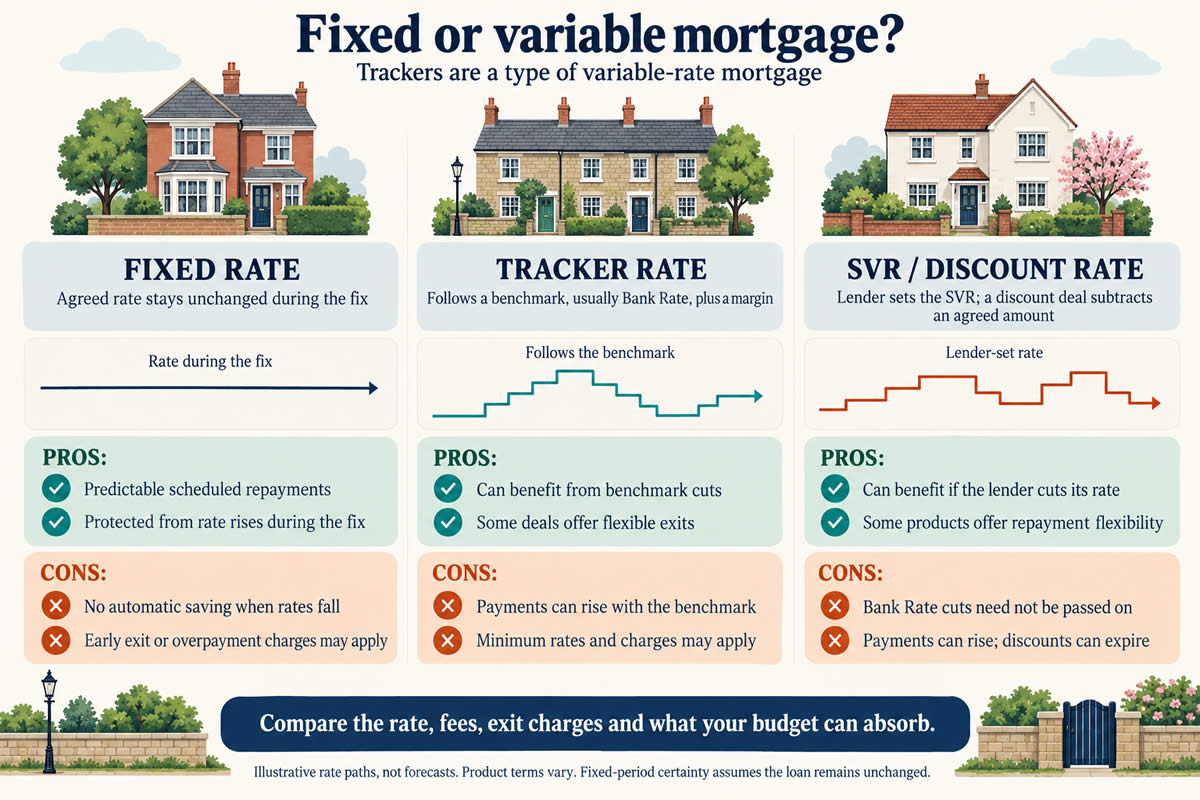
The four main rate types at a glance
| Rate type | What sets the rate? | What can change your payment? |
|---|---|---|
| Fixed | The rate agreed for the fixed period. | The fix ending, or a change to the loan itself. |
| Tracker | A named rate, plus or minus a set margin. | That rate moving, subject to your product’s timing and limits. |
| Standard variable rate (SVR) | Your lender. | The lender changing it, which doesn’t have to match Bank Rate. |
| Discounted variable | A set discount off the lender’s SVR for a period. | The SVR changing, or the discount ending. |
Fixed and variable describe how the interest rate works, not whether you’re repaying the loan. The payment examples here are for repayment mortgages.
Fixed-rate mortgages
On a five-year fix, changes to Bank Rate don’t affect your rate for those five years. As long as you don’t change the loan, your payment stays the same, which helps when other bills are less predictable.
The fix isn’t the same as your mortgage term. A 25-year mortgage might start with a five-year fix and still have 20 years to run when it ends. To compare fix lengths, see our guide to choosing a two-, five- or ten-year fixed rate.
The trade-off: you know your rate, but you won’t benefit if rates fall. Leaving early or overpaying above your allowance can trigger charges. A fixed mortgage also doesn’t fix your insurance, Council Tax or other bills.
Tracker mortgages
A tracker sets your rate using a formula in your agreement. Take a deal at Bank Rate plus 0.75 points. With Bank Rate at 4%, you pay 4.75%. If Bank Rate falls to 3.5%, you pay 4.25%, as long as no minimum rate applies. These are examples, not current rates.
A half-point drop in the rate doesn’t cut your payment by 0.5%. Your lender recalculates the payment from the new rate, what you owe and the time left, on the timetable set out in your product terms.
Before choosing a tracker, check:
- the margin over the tracked rate
- how quickly changes take effect
- whether there’s a minimum rate, known as a collar
- whether it tracks for a set period or the life of the mortgage
The Bank of England’s mortgage rate definitions explain the difference between fixed-term and lifetime trackers.
The trade-off: you benefit when rates fall, but you pay more when they rise. Some trackers have no early repayment charges or easy overpayment rules, but not all do, so read the charges before treating one as a short-term stopgap.
Standard variable rates (SVRs)
On an SVR, your lender decides when the rate changes and by how much. Bank Rate may influence that decision, but unless your contract says otherwise, there’s no promise that a Bank Rate cut will reach you.
You usually move onto an SVR or another follow-on rate when an initial deal ends. Some lenders have more than one follow-on rate. Nationwide, for example, uses a Base Mortgage Rate capped at 2 points above Bank Rate, and a Standard Mortgage Rate with no cap. Which you get depends on when you took your deal.
The trade-off: SVRs are flexible and rarely have exit charges, but they usually cost more than new deals. Compare the actual rate, fees and exit terms rather than assuming that staying is harmless or that switching always saves.
Discounted variable rates
A discount mortgage takes a set amount off the lender’s SVR for a period. If the SVR is 7% and the discount is 1.5 points, you pay 5.5%. If the SVR rises to 7.25%, you pay 5.75%. The discount stays the same, but your rate still moves.
A big discount isn’t always a good deal. It depends on the SVR it’s taken from. MoneyHelper’s guide to mortgage interest rate options shows how this works. Check what happens when the discount ends and whether there’s an early repayment charge.
What a rate change means in pounds
Take a £200,000 repayment mortgage with 25 years left. Keeping the balance and term the same shows the effect of the rate alone.
| Annual rate | Monthly repayment | Difference from 4.5% |
|---|---|---|
| 4.5% | £1,111.66 | — |
| 5.0% | £1,169.18 | £57.52 more |
| 5.5% | £1,228.17 | £116.51 more |
If you’re fixed at 4.5%, your payment doesn’t change when market rates rise. On a variable rate, your payment would be recalculated from your balance and remaining term at the time.
Use our UK mortgage calculator to test the rate you’ve been offered against a higher and lower one, keeping the balance and term the same. Then check whether the higher payment still fits your budget.
The examples assume interest charged monthly, repayments made monthly, and no fees or overpayments. Your lender may charge interest daily and round differently.
Which suits you, and what to check before a deal ends
Imagine a household with £150 left each month after bills and savings. A one-point rise in the example above would take £116.51 of that. That doesn’t decide the choice for them, but it shows that being able to absorb a rise matters as much as the starting rate.
If you might sell within a year, look closely at early repayment charges and whether you can take the deal with you, whatever the rate type. Even a portable deal depends on the lender approving the new property.
When comparing deals, note the payment, fees, overpayment rules, exit charges and the rate you’ll move to afterwards. For variable deals, test a few rate scenarios. Neither type is always cheaper.
As your current deal nears its end, note the end date, your follow-on rate and when any early repayment charge stops. You can usually take a new deal with your lender or remortgage elsewhere. Include fees when you compare.