How Does a Larger Deposit Affect a Mortgage?
Put down more upfront on the same property, and you'll borrow less. With the rate and term held steady, that means a smaller monthly repayment and less interest paid over the life of the loan. It also lowers your loan-to-value ratio, which can open the door to a different set of mortgage deals altogether.
Two separate things are happening here: you're borrowing less, and you might qualify for a better rate. The first is straightforward maths. The second depends entirely on the lender's products and your own circumstances. And either way, you still need to think about how much cash you'll have left once you've moved in.
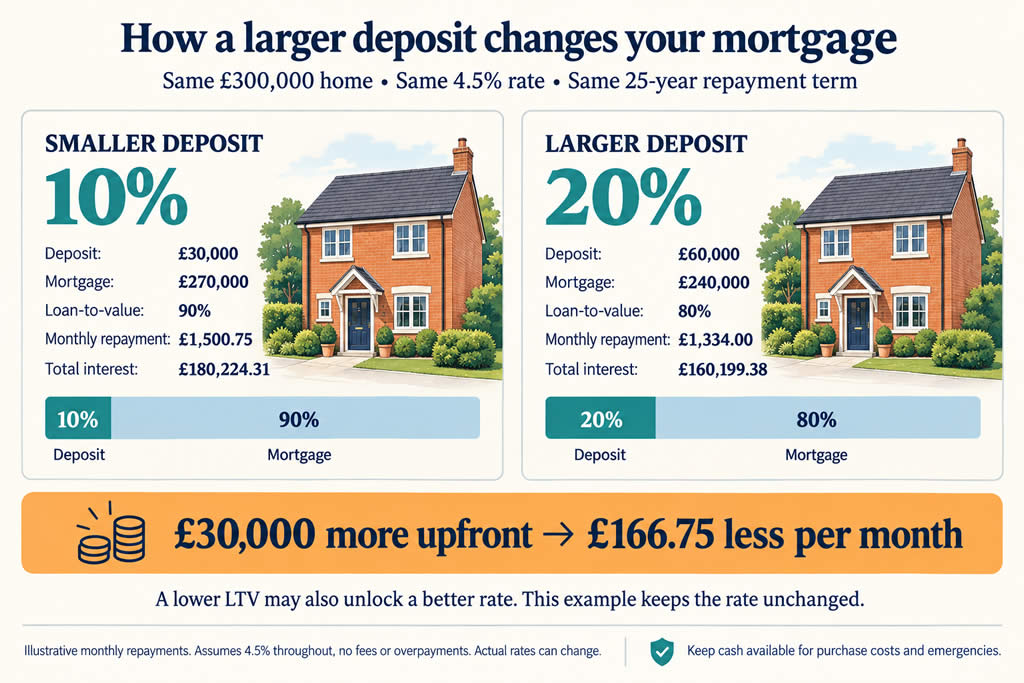
A larger deposit means a smaller loan
Say you're buying a £300,000 home. Put down £30,000 and you're borrowing £270,000. Push the deposit up to £60,000, and the loan drops to £240,000 - before any fees get added on top.
The table below holds the rate at an illustrative 4.5% and the term at 25 years throughout, so you're seeing the deposit's effect in isolation, not assuming a better deal comes with it.
| Deposit | Mortgage | Loan-to-value | Monthly repayment | Total interest |
|---|---|---|---|---|
| £30,000 (10%) | £270,000 | 90% | £1,500.75 | £180,224.31 |
| £45,000 (15%) | £255,000 | 85% | £1,417.37 | £170,211.85 |
| £60,000 (20%) | £240,000 | 80% | £1,334.00 | £160,199.38 |
Going from a 10% to a 20% deposit knocks £166.75 off the monthly payment. Under these constant-rate assumptions, it also saves around £20,024.92 in interest over the full term. Worth remembering: that extra £30,000 deposit is your own money going toward the home upfront - it's not itself an interest saving, it's the reason the saving happens.
These figures assume standard capital-and-interest repayments, monthly interest at the annual rate divided by 12, and no fees or overpayments. We've kept the rate fixed for the full term purely for comparison - real rates move between deals. And because each total is rounded separately, you might see the odd penny of difference if you add things up by hand.
Want to run your own numbers? Try our UK mortgage calculator and keep the price, rate and term fixed at first, so you can see exactly how much of the saving comes from borrowing less.
What a bigger deposit does to your LTV
Loan-to-value - LTV - is simply your mortgage as a percentage of the property's value. For a normal purchase where that value matches the price:
LTV = mortgage amount / property value × 100
£270,000 against a £300,000 home comes out to 90% LTV. Drop the loan to £240,000 and you're at 80%. You can check your own figures with our UK loan-to-value calculator.
Lenders set maximum-LTV limits to decide which products you can access. MoneyHelper's guide to saving for a mortgage deposit covers how a lower LTV can open up better deals - though it's worth being clear that not every extra pound of deposit automatically buys you a lower rate.
Why crossing an LTV threshold matters more than you'd think
Say a lender caps a particular product at 85% LTV. On a £300,000 property, that's a maximum loan of £255,000. A buyer with a £42,000 deposit needs to borrow £258,000 - 86% LTV, just over the line. Add £3,000 more to the deposit, and they land exactly on the 85% threshold.
If that product's available and the buyer clears the other checks, that extra £3,000 could change which rate they get. Compare that to adding just £1,000 instead - the loan still shrinks, but it stays above the threshold, so the pricing doesn't budge.
Get real quotes on both sides of a threshold before assuming a nice round percentage guarantees the best deal - compare fees and deal length too, not just the headline rate. And if you do land a better rate, rerun the repayment numbers using that actual quote and the smaller loan - keep that separate from the same-rate table above, since it's now capturing two effects at once: less borrowing and better pricing. Also worth checking how the lender treats any fees rolled into the loan when it calculates your LTV.
The lender's valuation can throw the numbers off
The price you've agreed with the seller isn't automatically the value a lender will lend against. Nationwide's first-time buyer guide describes the valuation as a check carried out during the application.
Say you've agreed £300,000, but the lender values the property at £290,000 and caps lending at 90% LTV. That puts the borrowing ceiling at £261,000 - and affordability or other criteria could push the actual offer lower still. Even at the full £261,000, completing at the original price now means finding £39,000 rather than £30,000, on top of other purchase costs.
This is just an illustration of what a valuation shortfall looks like, not a prediction of what'll happen to you. Talk to your lender about how they approach valuations before assuming a calculator result based on the asking price will match what they actually offer.
Does a bigger deposit guarantee you'll be approved?
No. A smaller loan is easier to support on paper, but lenders still look at your income, existing commitments, credit history and the property itself. A large deposit doesn't get you around any of that.
If you're trying to work out how much you could actually borrow, our UK mortgage affordability calculator is a good starting point - then check the repayments against your real household budget. A lender or mortgage adviser can look at what's genuinely available to you.
You'll likely need to show where your deposit came from, too. Nationwide's application documents guide, for example, lists deposit evidence among the paperwork you'll need. If part of it's a gift, check your lender's requirements before you count on it.
More equity is a buffer, not a guarantee
Assuming the property's worth what you paid for it, a bigger deposit gives you more equity from day one - and a wider margin before a drop in value tips you into negative equity, where your mortgage owes more than the home is worth.
Simplified example: say that £300,000 home drops to £255,000 before any repayments are factored in. A £270,000 loan now exceeds the property's value by £15,000. A £240,000 loan still leaves £15,000 of equity.
Both owners have absorbed the exact same £45,000 fall in value. The bigger deposit just changes where each of them stands on paper - it doesn't stop the loss happening, and it doesn't guarantee they'll be able to remortgage.
Should you put every penny of savings into the deposit?
A lower monthly payment is tempting, but money that's gone into the property isn't easy to get back out again - you'd generally need to sell or borrow against it, with costs and eligibility checks either way.
Keep your deposit separate from what you'll need for legal fees, surveys, moving, repairs and any tax due. Leave yourself a cushion for the unexpected and for any gap in income. There's no universal "right" deposit size - it comes down to your own situation.
£50,000 in savings isn't the same as a £50,000 usable deposit if £8,000 of it needs to cover purchase costs and reserves - that leaves £42,000 actually available. Run your comparisons using the number you can genuinely commit, not your full savings balance.
It's also worth weighing up other debts you're carrying and what your savings could be earning elsewhere, after tax. The smallest possible mortgage isn't the only thing that matters - having money you can actually access matters too.
Is it worth waiting to save a bigger deposit?
It can be, if the extra saving genuinely cuts your borrowing by a meaningful amount or gets you over a useful LTV threshold. But factor in the cost of continuing to rent, how long the saving will actually take, and the fact that both property prices and mortgage rates could move while you wait.
Compare a purchase you could make now against a realistic later scenario - don't assume the price or the rate will simply sit still while you save. And don't let a self-imposed deadline push you into a mortgage that only works under the rosiest assumptions.
How to compare two deposit amounts
- Set aside your purchase costs and reserves first. Work out what cash is genuinely free for the deposit.
- Calculate the loan and LTV for each option. Use the same property price, and check how the lender's own valuation might differ.
- Compare repayments at the same rate first. This isolates the effect of borrowing less.
- Get real quotes at each LTV level you'd qualify for. Look at fees and deal length alongside the rate.
- Check what's left in the bank afterwards. Make sure the lower payment isn't coming at the cost of covering everything else.
A bigger deposit can genuinely cut your borrowing costs and give you a stronger equity position from the start. Its real value only becomes clear once you've compared the monthly saving, the deals actually on offer, and what you'll have left once you've moved in.
Common questions about mortgage deposits
General information about UK mortgages, not personalised financial advice. Prices, rates, valuations and product thresholds are illustrative. Confirm eligibility, costs and loan terms with your lender or mortgage adviser.